Pedro Muzquiz
Like Water for ChocolatePedro Muzquiz is Tita’s beloved, whose effort to remain close to her turns a rejected marriage proposal into a marriage to her sister, Rosaura. His choices bind intimacy to concealment: he presents marriage as the only way to stay near Tita, later admits that the decision was a mistake, and eventually meets her in secret. Through him, the story makes the cost of a love obstructed by family authority visible in both private grief and uncanny public consequence.
Identity and the blocked proposal
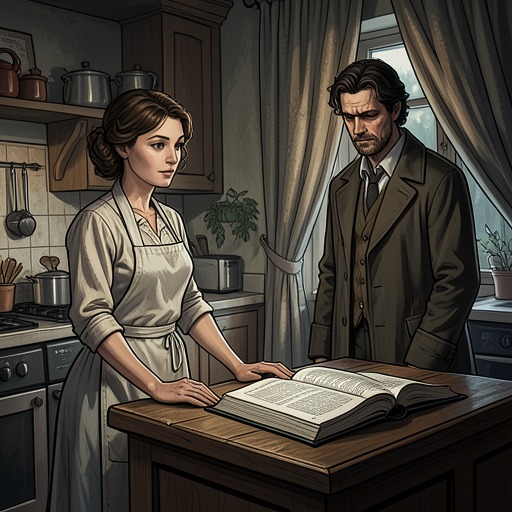
Pedro first arrives at the house with his esteemed father to ask for Tita’s hand. The visit surprises the household because Tita had sent him a message, through Nacha’s brother, asking him to abandon his suit; the brother had sworn he delivered it. Mama Elena receives the men politely but declares that Tita cannot marry. Her refusal makes the obstacle explicit, while the failed message leaves Pedro’s arrival looking, to the household, like an unexpected challenge to her authority.
Mama Elena answers Pedro’s request by offering Rosaura instead. Her proposal turns the rejected courtship toward an arrangement that keeps Pedro within the family but joins him to the wrong sister. Tita, Rosaura, and Gertrudis wait in the kitchen for news; Chencha rushes back from serving coffee and cookies to tell them what has happened. The scene’s domestic traffic carries the decision from the formal living room into the kitchen, where Tita’s private future is being discussed without her control.
A marriage chosen for proximity
Nacha later reports what she overheard as she escorted Pedro and his father to the ranch gate. His father challenges the decision as ridiculous and asks what has become of Pedro’s vow of eternal love to Tita. Pedro answers that when a man is told he cannot marry the woman he loves, marrying her sister may be his only chance to stay near her. The explanation presents the marriage not as a change of beloved but as a compromise with the prohibition: Pedro accepts a binding public relationship in order to preserve private proximity.
That compromise wounds Tita. On hearing that Pedro has agreed to marry Rosaura, she feels a sudden, lasting chill, and even Nacha’s account of his words brings no relief. Pedro’s choice therefore has two simultaneous meanings: to him, it keeps open a path toward Tita; to her, it confirms that the man she loves will marry her sister. The difference between intention and consequence is central to their relationship from its beginning.
At the wedding, Pedro makes that concealed intention plain to Tita. Holding her closer than convention permits, he whispers that the marriage has given him what he really wanted: the chance to be near the woman he loves. His words rekindle Tita’s happiness after months of hiding her feelings; his breath and touch make that relief visible in her changed expression. Mama Elena notices the intimacy and immediately asks what he said. Pedro’s declaration thus restores hope between the lovers while also reminding them that their closeness must be guarded from Tita’s mother.
Confession, promise, and belated regret
Pedro’s love is also established in a private encounter when his hands accidentally touch Tita’s as they bend to pick up the same tray. He uses the moment alone with her to confess that he is deeply in love, acknowledge that the declaration is sudden and presumptuous, and ask whether he can hope to win her affection. Tita asks for time to think. Pedro presses for an immediate answer, insisting that love is felt rather than reasoned out, and pledges that his own love will last forever. The exchange gives their attachment the form of a vow, but its urgency also shows how little room they have for an ordinary courtship.
Years later, Pedro urges Tita not to marry John Brown. Tita objects that Pedro did not ask her to stop his own marriage, though the wedding destroyed her. Pedro answers that he repents that decision wholeheartedly: marrying Rosaura had been an attempt to reach Tita, but it did not work, and he now believes he should have run away with her instead. His confession revises the meaning of his earlier compromise. What once seemed to him a way to preserve their bond has become, in retrospect, a failed substitute for choosing Tita openly.
Tita refuses the belated appeal. She tells Pedro that he has spoken too late, asks him never to bother her again, and warns him not to repeat the confession where Rosaura might hear it and suffer. She ends by calling him a coward for failing to act when he had the chance. Her rebuke identifies the cost of Pedro’s strategy: proximity did not secure a life together, and his later regret cannot undo the marriage that divided the sisters’ lives.
Secret reunion and narrative consequence
Despite that rejection, Pedro later enters the dark room where Tita is alone. When she turns and asks what he is doing there, he does not answer. He goes to her, extinguishes the lamp, and takes her to a brass bed that had belonged to Gertrudis. The encounter causes Tita to lose her virginity and, in the narration’s phrasing, learn of true love. Its secrecy contrasts sharply with Pedro’s earlier public request to marry Tita: the relationship that began with a formal proposal is consummated away from the light and without explanation.
The encounter is followed by a spectacle visible from Rosaura’s bedroom. As Rosaura walks her crying daughter past the window, she sees phosphorescent plumes rising from the dark room toward the sky like Bengal lights. Her calls for Tita and Pedro receive no answer. Chencha, searching for sheets, is struck silent with surprise, while the baby stops crying; Chencha kneels, crosses herself, and prays that Mama Elena’s wandering soul may find rest. The scene binds Pedro and Tita’s secret intimacy to an event that the household can witness but cannot explain, turning a private union into a disturbance in the ranch’s shared world.
Narrative role
Pedro’s defining conflict is between declaring an enduring love and acting decisively on its behalf. He asks for Tita, accepts Rosaura when refused, and later regrets not having run away with Tita; each turn changes the emotional meaning of the one before it. His persistence sustains the forbidden-love plot, but the narrative does not treat devotion as enough to erase the consequences of his decisions. The marriage he calls a route to Tita becomes a source of pain, his delayed reconsideration earns Tita’s anger rather than reconciliation, and their eventual secret meeting carries its own visible, unsettling aftermath.